Today, we’re releasing Squad 1.0.1.
Yes, 1.0.1.
We shipped 1.0.0, immediately found a few things we wanted to tighten, and followed it with a focused patch. That is a fairly honest introduction to how Squad works: build with agents, keep people responsible for the decisions, inspect the result, and improve the system while the context is still fresh.
The larger milestone is 1.0. Squad’s CLI and SDK are now stable foundations for a simple idea:
Give a developer a persistent, human-directed team of AI agents that lives with the repository, learns the project, divides work by specialty, and leaves behind inspectable state.
Squad cast members have distinct identities and responsibilities, durable project memory, shared decisions, and explicit boundaries around what they may do without a person. The team survives the conversation because its useful context lives with the code, where people can review it, correct it, and version it.
Human-led is not a slogan; it is an architectural constraint. Agents can research, plan, implement, review, and coordinate. People still own priorities, approvals, protected changes, and final merges. Automation increases reach without quietly acquiring authority.
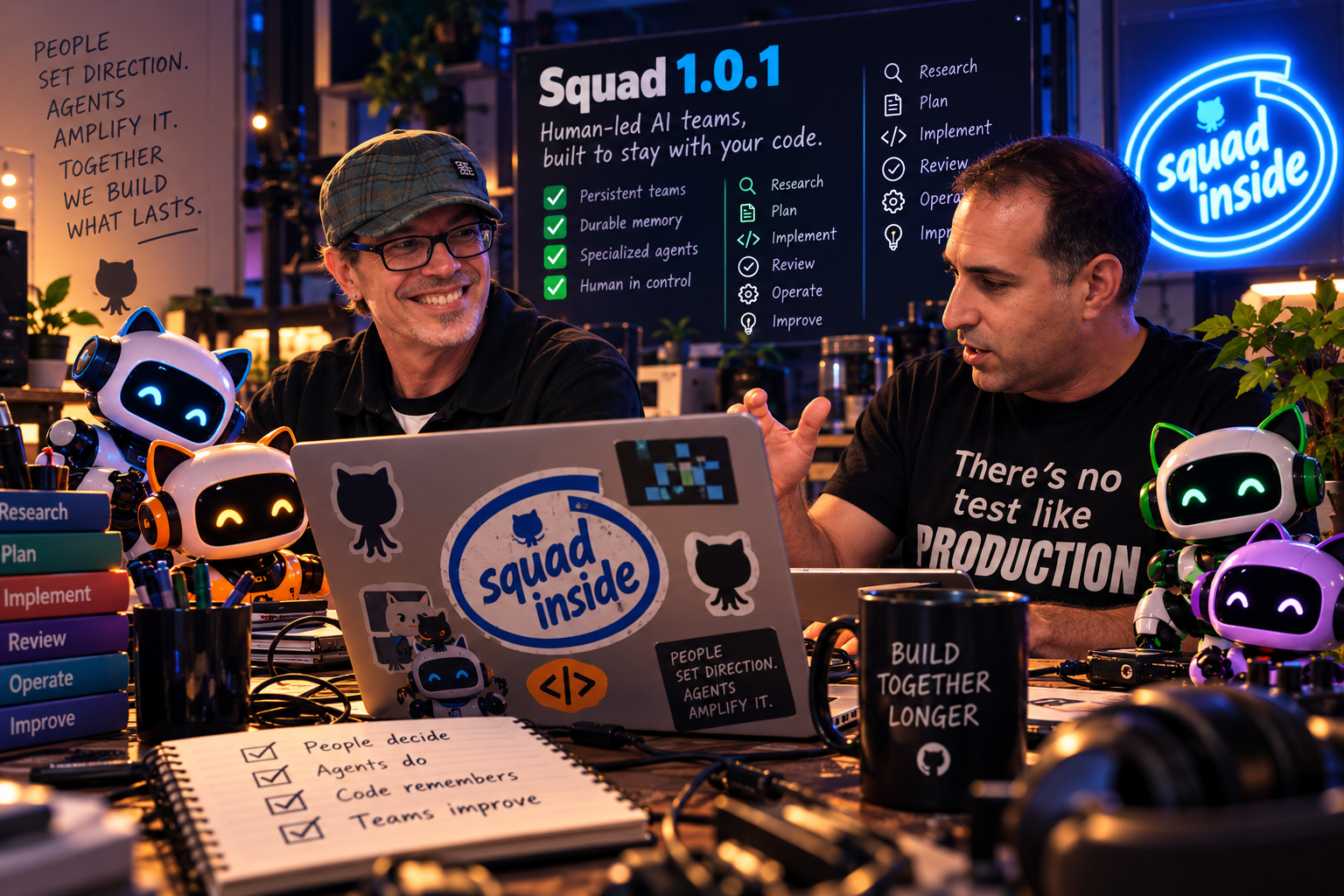
Squad itself is built this way. Tamir Dresher and I created it with a growing team of specialized agents helping us research, implement, test, review, document, and operate the repository. Version 1.0.1 is the first stable foundation for that model—and a very human reminder that stable software still improves one careful patch at a time.
The rest of this post covers what changed in 1.0, what 1.0.1 tightens, and how Squad Agentic Workflows turn a persistent team into a reviewable software-delivery system.
What’s new in Squad 1.0
Squad 1.0 is a stabilization release, but the work since the previous official release reaches across onboarding, identity, state, governance, reliability, distribution, and the GitHub-native lifecycle. The central theme is trust: teams are easier to start, safer to run, and more durable when work crosses sessions and repositories.
Easier repository onboarding
A new safety-gated enlistment experience installs Squad’s native GitHub Agentic Workflow package at an explicit source revision. After the installation pull request is reviewed and merged, bootstrap analyzes the repository and produces a validated Cast proposal plus research opportunities. When repository token policy prevents a workflow from opening the Cast pull request directly, Squad falls back to a human-opened pull-request path rather than weakening permissions.
Stable agent identity and durable team state
Agents now have stable IDs that survive renames, retirement tombstones that preserve historical meaning, and implementation provenance tied to the exact casting-registry revision. Registry and history updates use shared locking, manifest-backed transactions, interrupted-commit recovery, and consistency-aware readers so ambiguous or split generations fail closed instead of becoming silent team-state corruption.
Research and continuous improvement
Research can use online documentation while retaining complete source URLs, and repositories can opt into a committed bootstrap research scope. Retrospectives can run on schedules or evidence triggers, create action issues, and—when explicitly allowed—dispatch bounded implementation. Governance-scoped improvements still require human approval, and retries are independently reconciled rather than assumed safe.
Reliability where it matters
The 1.0 work hardens Windows casting and initialization around fsync, rename contention, lock release, and diagnostics. Linked teams now resolve both supported team-root forms consistently across watch, loop, cast, state tools, and doctor. Workflow fixes also repair fork-pull-request heartbeat behavior, preserve approved scope, strengthen command relays, and keep real team state routed to the effective state directory.
Governance and installation integrity
Built-in support agents remain isolated from the routable product cast, and product templates, CI, and issue routing no longer drift into live team identity. Workflow review is source-bound; actor and author checks are stricter; edited-command replay is prevented; approval and revocation are revalidated. The installation contract pins and verifies the supported gh-aw compiler and Squad source revision, checks package ownership and artifact digests, and uses deterministic validator delivery with bounded, integrity-checked payloads.
Stable packages and broader distribution
The @bradygaster/squad-cli and @bradygaster/squad-sdk packages graduate to 1.0. The release pipeline supports npm, standalone archives, Homebrew, and WinGet, while Squad.Agents.AI remains separately versioned on NuGet. Blanket alpha banners were removed from the documentation, but feature-specific preview and security warnings remain where they belong.
Squad for .NET
Squad.Agents.AI exposes a Squad team as a Microsoft Agent Framework AIAgent. Its stable 1.0 package supports .NET 8, 9, and 10; Microsoft Agent Framework 1.23.0; GitHub Copilot SDK 1.0.14; dependency injection; streaming; and OpenTelemetry-aware integration. It gives .NET applications a typed, DI-friendly route to the same persistent team model.
Turn on Squad Agentic Workflows—and meet your team
Squad’s first-class integration with GitHub Agentic Workflows (gh aw) makes getting started with Squad a GitHub-first experience. Turn on the Squad workflows and Copilot automatically reviews the repository to understand what it contains, how it is structured, and where a specialized team could help.
From that review, Squad creates two concrete, reviewable starting points:
- A pull request containing the proposed Squad team charters, so you can inspect and refine the agents, their specialties, and their responsibilities before the team becomes active.
- An issue summarizing what the Squad should work on, based on opportunities Copilot found while reviewing the repository.
Once you approve the team, the same Squad can continue working through GitHub issues using /squad commands for research, planning, implementation, review, and retrospectives. The team carries its identity, memory, routing, and decisions across the lifecycle instead of starting from scratch at each step.
The important boundary stays human: workflows can analyze and propose, but you review the charters, decide what work matters, and merge the pull request that activates the team.
Read the Squad Agentic Workflows guide
Why 1.0.1 followed so quickly
Shortly after publishing 1.0.0, we found a focused set of release and activation details we wanted to correct immediately. Rather than treating the version number as ceremonial, we treated the release like any other production change: inspect the actual result, preserve CI and independent-review gates, and prepare a surgical patch instead of pulling unrelated work into the release branch.
The 1.0.1 work tightens health routing, adds post-merge contract coverage, aligns CLI and SDK release metadata, repairs publishing authentication for external-repository distribution, and removes a stale activation version pin so new workflow installations follow the intended stable release. Every combined release head still receives fresh CI and review; an approval on an earlier head is not treated as approval of new changes.
That is the human part we want to keep. Agentic development can make software move faster, but speed does not eliminate release engineering. Packages must agree on versions. Installation paths must be tested. Distribution channels must be verified. The final head still needs an independent reviewer. Agents can discover, diagnose, prepare, and validate. People decide what ships.
Upgrade note for linked teams
This release should not be described as universally “no breaking changes.” The linked-team work adds a required ResolvedSquadPaths.teamSquadDir field for SDK consumers that construct that type. Teams linked under older path behavior may also have state at the team repository root that now belongs under the team’s .squad directory.
Squad does not automatically move or overwrite that state. Run squad doctor to identify leftovers, then move or merge them carefully into the corresponding paths under <team>/.squad. Preserve newer state and do not replace existing directories wholesale.
Get Squad
Install or update the CLI through npm:
npm install -g @bradygaster/squad-cli@latestStandalone archives are available from GitHub Releases, with Homebrew and WinGet distribution tracked through the release process. Then initialize a team:
squad initOr start with a ready-to-use default cast:
squad init --preset defaultOpen GitHub Copilot CLI with the Squad agent:
copilot --agent squadDescribe what you are building. Squad will propose a team. You remain in control of the cast and the work it takes on.
Built by people, accelerated by agents
Squad 1.0 is not the finish line. It is a stable foundation for durable collaboration: teams that can specialize, remember, coordinate, and improve without becoming opaque. The draft Core and Charter specification work begins describing that model beyond one implementation, but it remains draft work—not a finalized interoperability standard.
We would love to see what you build with Squad—and what your Squad becomes along the way.